
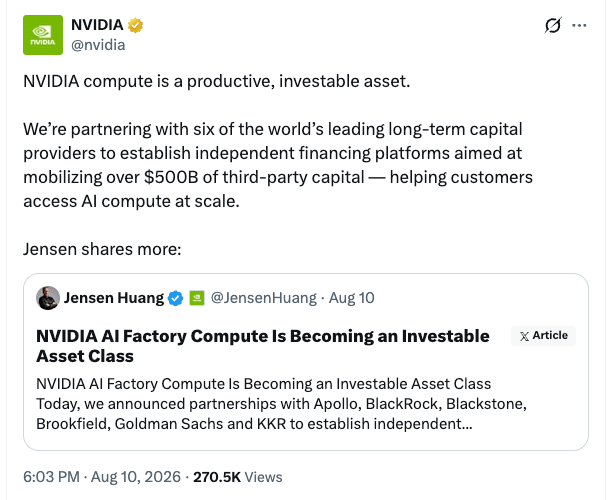
This week, Nvidia gathered Apollo, BlackRock, Blackstone, Brookfield, Goldman Sachs, and KKR around a $500 billion ambition. The announcement gives the market a neat launch date for AI infrastructure finance, though the machinery had been arriving one GPU-backed deal at a time.
CoreWeave closed a $3.1 billion publicly syndicated term loan in May. Nebius followed in July with a $775 million facility backed by deployed GPUs and contracted cash flows from an investment-grade customer. Nvidia now wants to turn those individual precedents into a repeatable market, with six financing platforms capable of bringing far more institutional capital into the AI buildout.
For the moment, those platforms remain memorandums of understanding (MOUs). The $500 billion describes third-party capital they aim to mobilize over time, and the detailed terms still need to be negotiated. These are legitimate caveats, but the deal logic is easy to see: AI companies want more compute than many can comfortably finance, while Wall Street wants assets that can produce long-dated cash flows. Nvidia sits in the middle, trying to make the two ambitions fit.
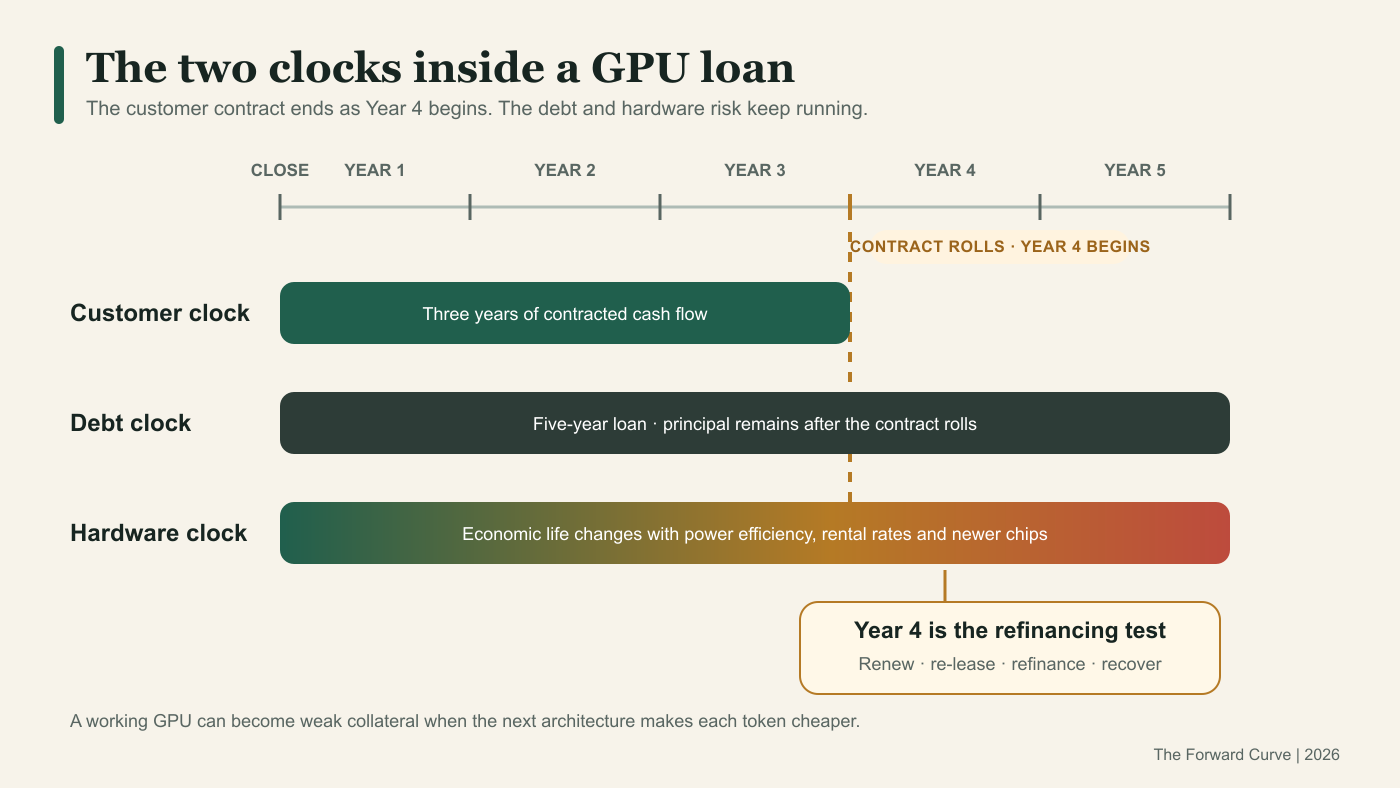
That fit depends on two clocks running at similar speeds: the customer’s contract and the GPU’s economic life.
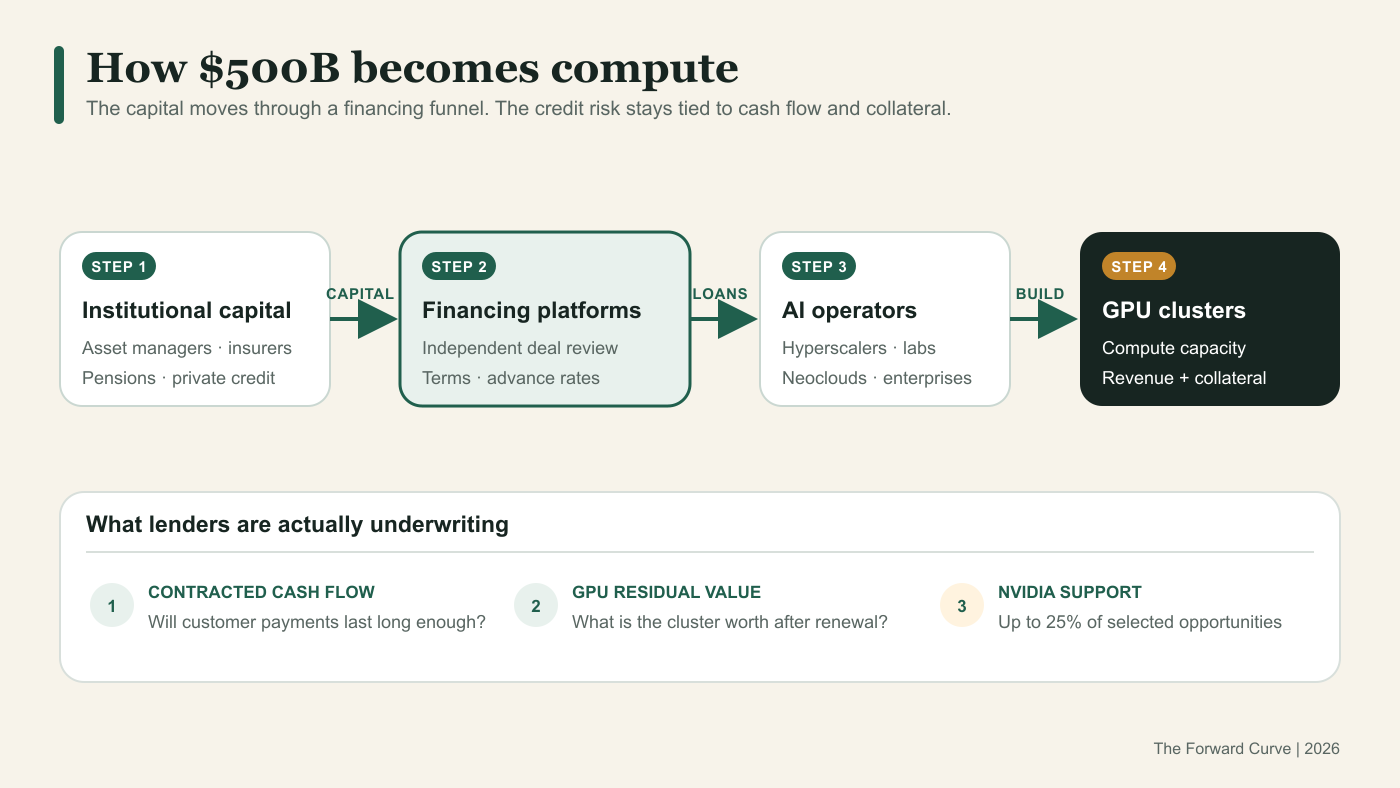
The market arrived, fast
AI infrastructure finance combines several familiar businesses inside one unfamiliar asset. The building, power, and cooling look like project finance. The GPU fleet looks like equipment finance. The customer contract supports the debt, while software compatibility and re-leasing determine what the equipment might be worth later.
CoreWeave’s May facility shows how the pieces can line up. Its $3.1 billion delayed-draw term loan funds GPU infrastructure dedicated to two customer contracts, matures in roughly 5.5 years, and prices at SOFR plus 4.50%. The funding schedule follows deployment and the expected useful life of the underlying GPUs.
Nebius used a similar logic in July. Its ~$775 million senior secured facility finances deployed GPU infrastructure against contracted cash flows from an investment-grade customer, with debt maturing in October 2030.
Capital markets can originate, structure, syndicate, and fund these assets. The plumbing works; a full credit cycle remains ahead. That cycle begins when contracts expire, hardware ages, rental rates move, and the lender discovers how much protection the original structure actually bought.
Nvidia’s six-platform coalition widens this existing funnel. More projects can reach credit committees, larger pools of capital can fund them, and institutional investors can absorb the exposure.
Wall Street brings capital, Nvidia brings chips, and the data centers rise.
Off into the sunset we ride. AI gets stuffed down our throats.
And then the loan begins aging…
Every GPU loan starts two clocks
Consider a 5-year loan used to finance $100 of GPU equipment, supported by a 3-year customer contract. The lender advances $80. During the first 3 years, the customer payments cover interest and repay part of the principal, leaving $30 outstanding when the contract ends.
Year 4 is where the story changes. The lender now needs a renewal, a replacement customer, a refinancing, or enough equipment value to recover the remaining debt. The original customer may have paid every invoice on time, yet the next source of repayment depends on the economics the contract was designed to postpone.
That nuance matters because customer credit and customer ROI answer different questions. A well-capitalized company can honor a contract while its AI use case produces weak ROI. The loan performs through the first term, and the commercial result appears when the customer decides whether another three years of compute is worth the price.
Deloitte’s survey captures the current timing problem: 85% of 1,854 executives across Europe and the Middle East said their organizations had increased AI investment. Most reported a two-to-four-year path to satisfactory returns, while 6% achieved payback within one year. Spending can support today’s contract well before the customer has proved the economics required for tomorrow’s renewal.
The first clock is easy to read because it sits in the contract. The second clock runs inside the equipment, where each new chip iteration changes the economics of the generation already installed.
Nvidia is underwriting part of the second clock
A GPU has two useful lives: the physical life of the machine and the economic life of the cash flow it can produce after power costs, rental prices, and newer architectures enter the calculation.
That second life is harder to underwrite because technical progress can impair collateral without breaking it. A newer architecture may produce far more tokens per watt, pushing down the rental rate of an older fleet while the debt keeps its original amortization schedule. The servers remain warm, the fans keep spinning, and the recovery value still falls.

KBRA, the rating agency, treats this as a hybrid credit problem spanning project finance, structured finance, and corporate credit. Its framework asks lenders to examine contract durability, hardware competitiveness, refresh requirements, re-leasing, residual value, debt-service coverage, and refinancing risk. Each variable leads back to the same practical concern: how much cash can this cluster produce when the first customer leaves?
Nvidia’s answer centers on redeployability. The company argues that its GPUs can move across customers, operators, models, and workloads, while CUDA improvements extend the economic tail of hardware already in the field. A broad base of developers and users should create more potential homes for an older cluster, which is why Goldman CEO David Solomon sees an opportunity to build a market for credit backed by Nvidia compute.
The sentence I keep circling appears in Jensen Huang’s longer explanation of the deal. Nvidia may provide project-specific residual-value support for up to 25% of selected opportunities. That credit enhancement can lower financing costs and increase advance rates, while leaving Nvidia with contingent exposure to the future value of the equipment.
The exact trigger mechanics and first-loss allocation will sit in various credit agreements somewhere. But their importance is already apparent - Nvidia is asking outside capital to finance its customers while retaining the option to support the collateral value that makes those loans easier to write. The financing platform expands demand for Nvidia hardware, and some of the obsolescence risk can travel back toward Nvidia.
A rational loan can still join an excessive market
A credit committee can underwrite one cluster using customer contracts, collateral, sponsor support, and conservative advance rates. A market full of clusters creates a different problem because every borrower is racing toward the same uncertain pool of future AI demand.
A July 2026 Bank for International Settlements (BIS) paper matters here for a specific reason. It models AI investment as a winner-take-most contest in which firms benefit from committing early, since delay may surrender the future market. Calibrated against balance-sheet and deal data, the model estimates investment at roughly 1.5 times the efficient level in its baseline. The estimate rises toward three times when demand responds less to price.
Financing gives that race a wider track. More capital shortens the distance between a product roadmap and concrete being poured, while customer contracts and collateral can make each individual project look sensible at closing.
Wall Street can underwrite its way into an AI glut.
The stress arrives later through overlapping capacity, lower utilization, weaker renewal pricing, and aging GPUs offered into the same secondary market. The contract carries the first term, and the renewal reveals whether customer ROI can support another. Re-leasing and resale values then show whether the hardware clock kept pace with the debt.
Nvidia has a credible answer to part of that risk. CUDA can preserve the usefulness of older chips, a deep user base can support redeployment, and strong contracts can carry a project across hardware generations. Rapid growth in AI productivity could also validate far more capacity than today’s economics imply.
The market still needs the evidence that only time can produce: funded capital, contract renewals, utilization across GPU generations, rental-rate curves, support triggers, refinancing outcomes, and recoveries. Those data will show how the two clocks behave once the first wave of loans reaches year four.
The $500 billion headline will fade. Renewal pricing and residual values will tell us whether Wall Street financed durable infrastructure, or a very expensive generation of silicon.
Sources:
- FT: Wall Street giants partner with Nvidia on $500bn AI financing deal
- Bloomberg: Nvidia’s Show of Financial Force Soothes Credit Markets
- BIS Working Paper No. 1367: The AI investment race
- CoreWeave: $3.1 billion publicly syndicated GPU-backed facility
- Nebius SEC exhibit: $775 million secured facility
- Deloitte: AI ROI — rising investment and elusive returns
- Nvidia: $500 billion compute financing platforms
- Jensen Huang: Nvidia AI factory compute is becoming an investable asset class
- KBRA: AI compute infrastructure credit considerations