
The AI trade has found the part of the portfolio that was supposed to calm everyone down.
The Financial Times’ Swiss-credit headline captures a broader reversal: a company can raise money across more currencies and markets while investors become increasingly exposed to the same company. For someone holding its shares and a bond fund buying its debt, ‘diversification’ requires a closer look.
The AI borrower finds a new pocket of demand
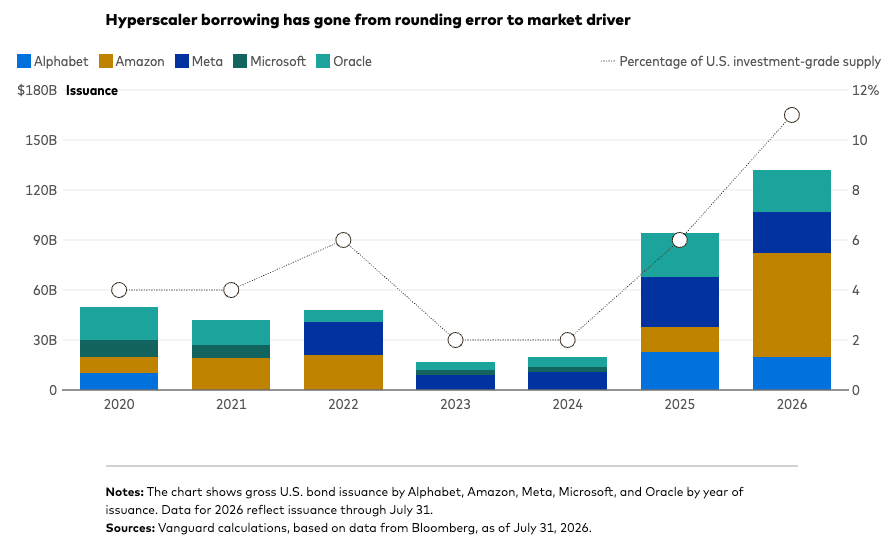
Hyperscaler issuance reached $220 billion through August 10, according to BNP Paribas data reported by Reuters. Four issuers had already surpassed their full-year 2025 total by July.
The international expansion was visible earlier: Reuters reported on June 1 that BofA estimated non-dollar issuance had doubled to 30% of total funding.
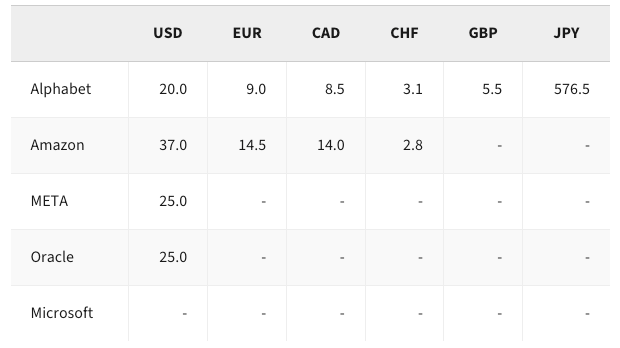
Borrowers reach another pool of savings; local investors get global businesses paying coupons in their currency. The complications begin when a large borrower meets a small market.
The benchmark imports the exposure
Aviva, an active manager with products to sell, put Alphabet and Amazon above 4% of the Swiss-franc corporate market using July 2 data. That is outstanding debt, a different denominator from annual issuance.
The same pair accounted for 9.22% of the S&P 500 on September 8, combining Alphabet’s share classes in State Street’s index weights. These are separate market weights; a portfolio’s allocation determines its combined exposure.
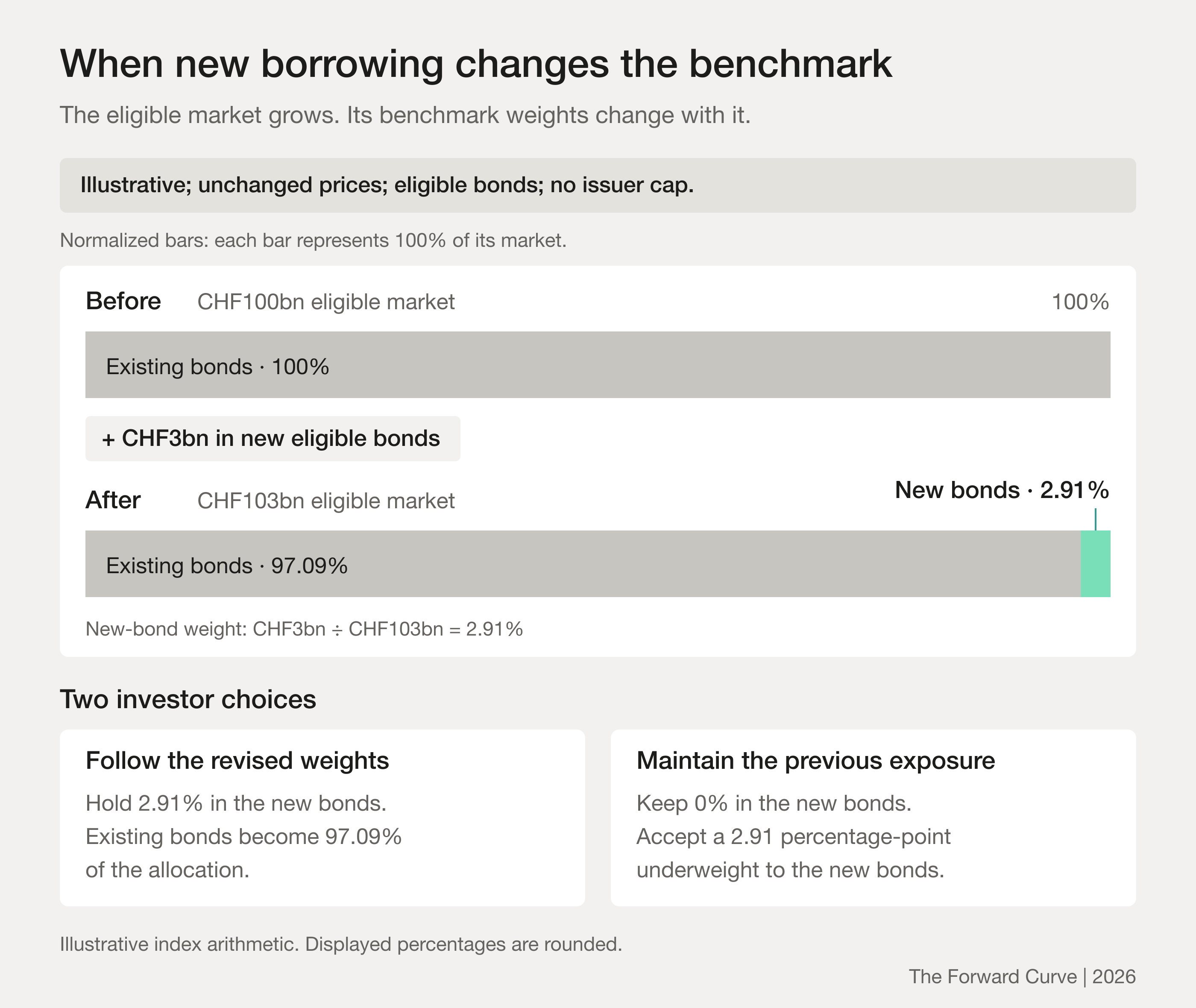
SIX’s standard bond-index calculation uses market value. Imagine an eligible market worth CHF100 billion receiving CHF3 billion of new bonds. With prices unchanged and no issuer cap, the new bonds represent about 2.9% of the enlarged index.
A tracker accommodates the change. An active manager can underweight it, accepting greater benchmark deviation. Maintaining the old exposure becomes an active decision.
Strong credits can still crowd a market
The European Central Bank’s August 31 blog explains why investors welcome the supply. Hyperscalers have brought higher-rated debt and longer maturities into euro credit, with limited crowding-out so far. Amazon’s C$14 billion Canadian deal reportedly attracted C$28 billion of orders in June. Buyers showed up voluntarily.
The ECB authors also identify the constraint: finite balance sheets and portfolio limits can force investors to sell other bonds to make room. Insurers and pension funds seeking high-quality, long-maturity assets may treat hyperscaler paper as a substitute for some safe-haven securities. Supply can change both the companies they own and the job those bonds perform.
That leaves the manager who likes the credit but dislikes the concentration explaining an underweight whenever the bonds outperform. Buying the benchmark requires considerably less explaining.
The company stands between the project and the bond
Alphabet’s CHF3.1 billion notes are senior unsecured debt. Repayment draws on the wider business, cushioning bondholders when individual projects disappoint.
Prices have already adjusted. Reuters’ July 29 analysis found median spreads for Amazon, Alphabet, Meta and Oracle widening from 30 to 40 basis points on two-to-four-year bonds, and 50 to 60 on five-to-seven-year paper, versus 2025. Buyers were demanding more compensation to absorb supply. Wider spreads pressure existing bond prices, other things equal.
The ECB adds a deeper caveat: ratings can depend on revenue-growth and leverage assumptions that fail to hold. Conservative portfolios can inherit that uncertainty alongside an investment-grade label. Repayment capacity and purchase price remain separate judgments.
The denominator is the decision
Vanguard warns that AI disappointment could weaken equities and corporate credit together. Government bonds retain a different role.
The buildout now draws financing through equities, corporate bonds across six currencies, and GPU-backed credit structures. They share exposure to AI investment earning adequate returns, with different repayment rights, buffers and other business exposures shaping their losses.
Diversification by wrapper is not diversification by risk factor.
The borrower gets more funding options. The investor can keep the same mandate while accumulating more exposure to the same spending cycle. The allocation deserves scrutiny before a familiar label does the underwriting.
Sources: